


Views: 0 Author: Site Editor Publish Time: 2026-07-31 Origin: Site


The modern pearl market offers massive variety, but the lack of a universally standardized grading system leaves buyers vulnerable to inflated claims and misrepresentation. Buyers constantly struggle to differentiate between naturally high-quality gems, chemically treated alternatives, and artificially inflated grading scales like "AAAA" grades. This confusion often leads to poor purchasing decisions and compromised jewelry longevity.
Understanding the physical properties of nacre, light refraction, and modern cultivation techniques is essential for navigating this market. This guide provides an evidence-based, technical checklist for evaluating Freshwater Pearls. By focusing on objective quality markers, grading realities, and risk mitigation, you can ensure a confident, secure purchase that stands the test of time.
Luster Dictates Value: Surface reflection and sharpness of light return are the most critical indicators of a freshwater pearl's quality and longevity, outweighing size or perfect roundness.
Grading is Subjective: The A-AAA grading scale is not regulated by a central governing body; buyers must evaluate the physical attributes rather than relying solely on the vendor's assigned letter grade.
Solid Nacre Advantage: Traditional freshwater pearls are nearly 100% solid nacre, making them highly durable compared to bead-nucleated saltwater varieties, though newer "Edison" freshwater pearls introduce bead nucleation for larger sizes.
Verification is Mandatory: Always verify vendor return policies, request unedited macro photography, and confirm whether colors are natural or color-treated before finalizing a purchase.
Table of Contents
To accurately evaluate any pearl, you must first understand how it grows and reaches the market. The biological and geographical origins directly influence the physical characteristics, durability, and overall market position of these gems. Field experience shows that knowing the cultivation background prevents you from falling for misleading marketing.
The cultivation environment and the host mollusk dictate the fundamental properties of the resulting gem. Freshwater cultivation occurs in lakes, rivers, and man-made aquaculture ponds, primarily utilizing the Hyriopsis cumingii, commonly known as the Triangle Sail Mussel. Saltwater cultivation happens in ocean bays and atolls using various oyster species like the Pinctada fucata or Pinctada maxima.
The most significant difference lies in the cost-to-yield ratio. A single saltwater oyster typically produces one or two pearls per harvest cycle. In contrast, a healthy freshwater mussel can produce up to 30 to 40 pearls simultaneously. This high yield drives down baseline costs, making freshwater varieties more accessible while still offering exceptional organic beauty.
Feature | Freshwater Cultivation | Saltwater Cultivation |
|---|---|---|
Environment | Lakes, rivers, aquaculture ponds | Ocean bays, atolls |
Host Mollusk | Hyriopsis cumingii (Triangle Sail Mussel) | Pinctada species (Oysters) |
Yield per Harvest | 30 to 40 pearls per mussel | 1 to 2 pearls per oyster |
Nucleation Method | Primarily tissue-nucleated (solid nacre) | Bead-nucleated (nacre over shell bead) |
The global supply chain is highly concentrated. Over 95% of the world's supply originates from specialized aquaculture farms in China. These farms have spent decades refining water quality management, mussel breeding, and grafting techniques to produce gems that rival premium saltwater varieties. The shift from wild harvesting to controlled aquaculture has stabilized the market and improved overall gem quality.
Historical and niche boutique production also occurs in Japan, specifically Lake Biwa, and the United States along the Tennessee River. Geographical origin impacts baseline costs, labor standards, and farming sustainability practices. Chinese aquaculture has advanced significantly, shifting from mass production of low-grade "rice" shapes to cultivating large, near-perfect rounds with metallic luster. When evaluating origin, focus on the physical output rather than romanticized geographical marketing.

Traditional freshwater cultivation relies on tissue nucleation. Technicians implant small pieces of donor mantle tissue into the host mussel without a hard shell bead. As the mussel secretes nacre to coat the irritant, the resulting gem becomes nearly 100% solid nacre. This biological process takes several years, requiring stable water temperatures and nutrient-rich environments.
This solid nacre composition provides a massive durability advantage. Traditional freshwater gems are highly resistant to chipping, flaking, and long-term wear. Unlike bead-nucleated saltwater varieties, where a thin nacre coating can wear away to reveal the internal shell bead, solid nacre gems maintain their structural integrity over decades of use. You can wear them daily without fear of the surface peeling off.
The introduction of Edison pearls revolutionized the market. These are bead-nucleated freshwater gems designed to bridge the size and shape gap between traditional freshwater harvests and premium South Sea varieties. Technicians implant a single round bead nucleus along with donor tissue, restricting the mussel to producing only one large gem per harvest. This mimics the saltwater cultivation process but utilizes the resilient freshwater mussel.
This technique yields massive sizes, often exceeding 15mm, with perfectly round profiles and intense metallic colors. However, bead-nucleated varieties require strict technical quality thresholds. The nacre thickness must be a minimum of 2.0mm to guarantee stability, prevent peeling, and ensure the internal bead remains invisible under strong light. Always inspect the drill hole of an Edison pearl with a jeweler's loupe to verify the nacre depth.
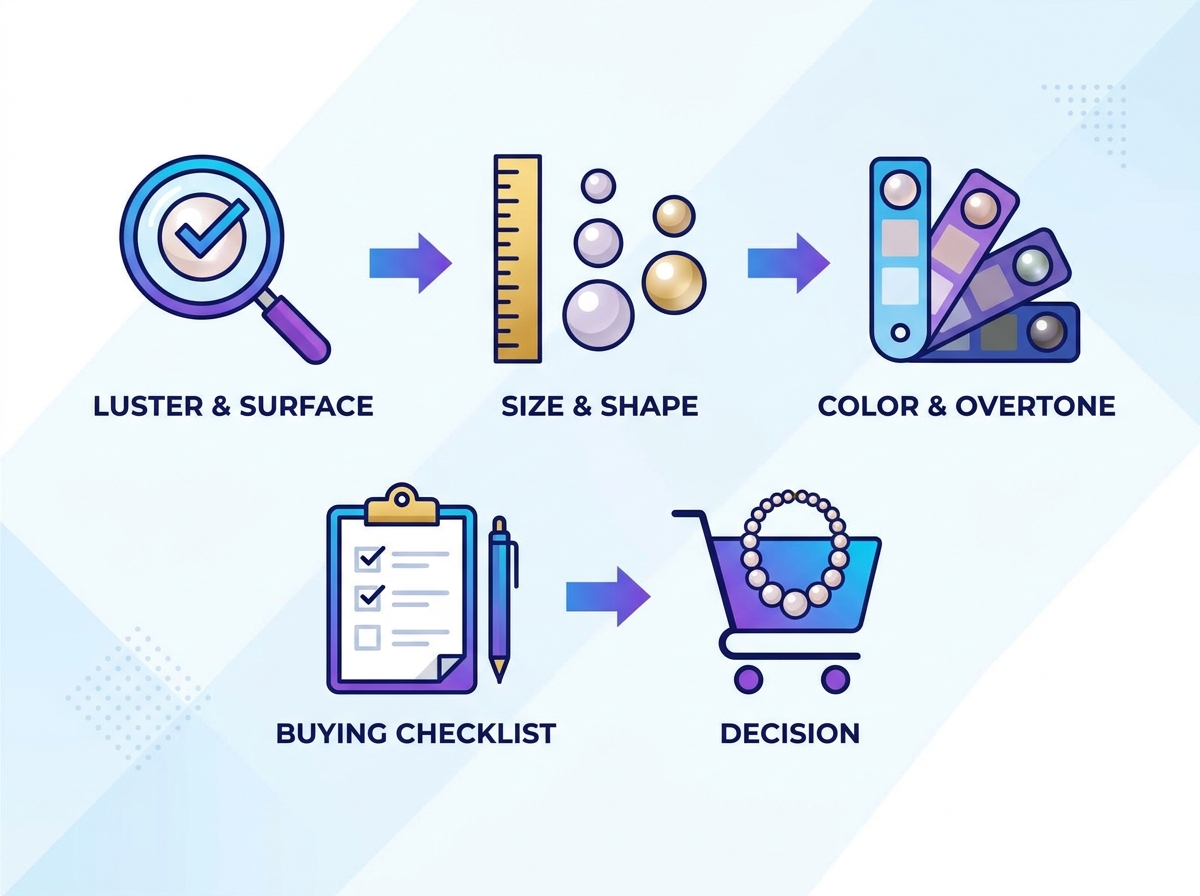
Evaluating organic gems requires a systematic approach. Relying on visual intuition alone often leads to overlooking critical structural flaws. Use this seven-point framework to assess physical attributes objectively. Bring a 10x loupe and a standardized daylight-balanced light source when inspecting inventory.
Luster is the rate of light reflection and the sharpness of the reflected image on the surface. It is the single most important factor determining visual appeal and longevity. High luster indicates tightly packed aragonite crystal layers within the nacre. When light hits these dense layers, it refracts brilliantly, giving the gem its signature inner glow.
When evaluating luster, look for a mirror-like finish. The margins of reflected light sources should be crisp, bright, and highly defined. A poor-quality gem will display a chalky, dull, or blurred reflection. If you cannot see a distinct reflection of your face or the surrounding room on the surface, the luster is substandard. Roll the gem under a bare bulb; the reflection should glide smoothly without breaking or dimming.
Because these are organic creations grown inside living mollusks, 100% flawless surfaces are statistically rare. Establishing realistic expectations is necessary for a successful purchase. Every harvest contains gems with minor growth characteristics. The goal is to identify which flaws threaten durability and which are merely cosmetic.
Identify acceptable versus unacceptable flaws. Minor pinpricks or light surface wrinkles near the drill hole are acceptable and do not affect durability. Deep cracks, pits, or flat spots that compromise structural integrity are unacceptable. As a general rule of thumb, blemishes should not be readily visible from a distance of two feet under natural daylight. Rotate the gem fully to ensure no major defects are hidden near the stringing wire.
Shape dramatically influences market value. The absence of a rigid internal bead in traditional cultivation makes geometric perfection incredibly rare. The mussel dictates the final form, resulting in a wide variety of organic shapes.
Shape Category | Description | Market Value Impact |
|---|---|---|
Perfectly Round | Less than 2% of traditional harvest. Symmetrical sphere. | Highest premium. Extremely rare in solid nacre. |
Off-Round / Oval | Slightly elongated or flattened. Appears round from a distance. | High value. Excellent for earrings and pendants. |
Drop / Teardrop | Symmetrical pear shape. | Highly sought after for specific pendant designs. |
Baroque | Asymmetrical, irregular, organic contours. | Valued for unique character and intense surface orient. |
Natural colors span a beautiful spectrum, but treatments are common in the lower-tier market. Knowing how to identify natural hues protects you from buying chemically altered products. The host mussel's genetics and the trace elements in the water determine the final body color.
Natural colors include white, peach, pink, and pastel lavender. Evaluate the overtones, which are secondary translucent colors like rose, silver, or green that float over the primary body color. Be highly suspicious of black, bright metallic blue, or highly saturated neon colors. These are universally dyed, chemically treated, or irradiated. Check the drill hole; dye often pools and concentrates around the edges of the hole.

Size is measured in millimeters and directly correlates with the time the mollusk spent in the water. Standard size ranges for traditional tissue-nucleated gems fall between 6mm and 10mm. Bead-nucleated Edison varieties typically range from 11mm to 16mm or larger. Use a digital caliper for precise measurements, as visual estimation is often inaccurate.
The price curve based on size is exponential, not linear. Value increases significantly at the 8mm, 9mm, and 10mm thresholds. Growing larger solid-nacre gems requires extended cultivation times, increasing the risk of mortality, storm damage, or disease to the host mussel. A 10mm perfectly round solid nacre gem represents years of flawless growth and commands a significant premium over an 8mm equivalent.
When purchasing a necklace strand or a pair of earrings, matching is a critical skill. You must assess the uniformity of the gems across all previous five factors. Poor matching disrupts the visual flow of the jewelry piece and indicates lazy sorting by the vendor.
A professional match requires gradual, symmetrical sizing. On a graduated strand, the sizing should taper smoothly near the clasp and peak at the center. Consistent overtone blending and uniform luster levels across the entire strand indicate careful sorting and high craftsmanship. Lay the strand flat on a white background to easily spot any gems that break the color or luster pattern.
Assess the structural composition carefully. While traditional tissue-nucleated gems are solid nacre, you must inspect bead-nucleated varieties for thin coatings. Thin nacre is a fatal flaw that cannot be repaired. It results from harvesting the mussel too early to rush the product to market.
Check for "blinking." This occurs when the nacre layer is too thin, allowing the internal striped shell bead nucleus to show through when rotated under a strong, direct light source. Blinking indicates a rushed harvest and guarantees the gem will peel or crack under normal wear. If you see dark bands or a dull, lifeless patch that shifts as you turn the gem, reject it immediately.
The jewelry industry lacks a centralized, legally binding grading authority for organic gems. Understanding how vendors assign grades is your best defense against marketing manipulation. You must rely on your own technical evaluation rather than the letters printed on the tag.
The A, AA, AA+, and AAA system is an industry convention, not a standardized system like diamond grading overseen by the GIA. Every vendor interprets these grades differently based on their own inventory quality. A AAA grade from a mall kiosk is vastly different from a AAA grade from a specialized aquaculture importer.
Baseline expectations for a true "AAA" grade should be strict. A AAA gem must feature a 95%+ blemish-free surface, near-perfect roundness, and mirror-like luster. If a vendor labels a chalky or heavily pitted gem as AAA, their entire grading scale is compromised. Always ask the vendor to define their specific parameters for each grade.
Teach yourself to read and cross-reference a vendor's proprietary grading chart. Look for clear definitions of what constitutes each grade regarding luster, surface blemishes, and shape. A trustworthy vendor publishes their grading standards openly and adheres to them strictly.
Vendors often manipulate grading charts by omitting key variables. For example, a vendor might grade a strand "AAA" strictly for its roundness while completely ignoring poor luster or thin nacre. Always evaluate the physical attributes comprehensively rather than accepting the assigned letter grade at face value. Cross-check the written description against high-resolution macro photographs.
Grade inflation is rampant in online marketplaces. The most common red flag is the "AAAA" or "AAAAA" marketing gimmick. Non-specialist vendors use these fabricated grades to artificially inflate perceived quality and justify higher margins. The recognized industry scale stops at AAA.
Relying on stock photography or heavy digital rendering is another major risk. Overly stylized studio lighting can hide surface flaws and artificially boost luster. Always demand raw, unedited macro photos or video of the actual lot you intend to purchase. If a vendor refuses to provide unedited images of the specific item, walk away from the transaction.
Even armed with technical knowledge, buyers often fall into predictable traps. Avoid these common mistakes to secure a high-quality investment. Field experience shows that these four errors account for the majority of buyer dissatisfaction.
Many buyers insist on perfect geometric rounds at the expense of light return. Buying a dull, chalky, perfectly round gem rather than an off-round or baroque shape with intense, reflective luster is a fundamental error. Luster is the single biggest contributor to visual beauty and durability. A highly lustrous oval will always look superior to a dull round. Prioritize the quality of the nacre over the geometry of the shape.
Be wary of massive, permanent markdowns advertising "80% off retail" on online marketplaces or television shopping networks. Authentic, high-grade gems require years of cultivation and skilled labor. They retain consistent market values. If a deal seems impossibly cheap, you are likely buying commercial-grade rejects, heavily treated inventory, or synthetic imitations. Quality aquaculture has a baseline cost that cannot be bypassed.
Purchasing budget-priced Edison varieties without verifying nacre thickness leads to rapid degradation. Thin, unstable nacre coatings will peel, crack, or lose luster within a few years of wear. Always ask the vendor to confirm the minimum nacre thickness and check for the "blinking" effect under strong light. Do not sacrifice structural integrity just to get a larger millimeter size.
Failing to differentiate between organic gems and synthetic glass, plastic, or shell-based imitations is a costly mistake. Fakes are often sold under deceptive names like "Mallorca," "organic shell," or "crystal" pearls. Real nacre feels slightly gritty when rubbed gently against the edge of your tooth, while glass or plastic feels perfectly smooth. Always perform the tooth test if you doubt the authenticity of the material.

Before finalizing any transaction, run through this vetting process. Holding vendors accountable ensures you receive exactly what you pay for. Treat the purchase like a technical procurement process.
Evaluate the seller's expertise and business practices. Does the vendor specialize exclusively in pearls, or are they a generalist department store jeweler? Specialists have better sourcing networks, stricter quality control, and deeper technical knowledge of their inventory.
Check for active memberships in recognized trade organizations, such as the Cultured Pearl Association of America. Finally, verify the return policy. A reputable vendor offers a clear, no-questions-asked return policy of at least 30 days, allowing you time for an independent post-purchase appraisal. Never buy from a vendor with a "final sale" policy on high-value items.
"Are these gems tissue-nucleated or bead-nucleated?"
"What is the exact geographical origin and cultivation source of this lot?"
"Is the color 100% natural, or have they been dyed, bleached, or heat-treated?"
"Can you provide unedited macro photographs of the specific strand or pair I am purchasing?"
"What is your defined criteria for the AAA grade you have assigned to this item?"
Rooted in Zhuji, China’s core freshwater pearl production region, Xueluo combines source-direct pearl farming and independent processing with AI-assisted sorting across size, luster, and roundness. Its integrated manufacturing, stable supply, rapid delivery, and flexible customization help wholesalers, retailers, and designers source consistent pearls and jewelry with greater confidence.
Take the following actions to secure a high-quality purchase:
Inspect luster first by looking for sharp, mirror-like reflections under natural daylight.
Request unedited macro photos from the vendor to verify surface cleanliness and overtone consistency.
Rub the gem gently against your tooth to confirm the gritty texture of authentic nacre.
Avoid vendors using AAAA+ grading scales or offering permanent 80% markdowns.
A: Traditional tissue-nucleated varieties are nearly 100% solid nacre and can last for generations with proper care. They resist chipping and peeling better than thin-nacre saltwater varieties. Keep them away from harsh chemicals, perfumes, and hairspray to maintain their luster.
A: Yes, but it is extremely rare for tissue-nucleated varieties, accounting for less than 2% of a harvest. Bead-nucleated Edison varieties are specifically cultivated to be perfectly round and achieve large sizes.
A: Low prices usually indicate commercial-grade harvests with poor luster, heavy surface blemishes, or potato-like shapes. Mass-produced, low-quality lots flood the market, while top-tier, lustrous rounds remain rare and command premium values.
A: On the standard industry scale, AAA represents the highest quality. However, because grading is unregulated, a AAA from a discount seller may equal an A grade from a high-end specialist. Always evaluate the physical attributes yourself.
A: No. There are no naturally black freshwater varieties. Any black, dark gray, or bright neon colors on the market have been achieved through dyeing or irradiation treatments. Natural colors are limited to white, peach, pink, and lavender.
A: Wipe them gently with a soft, damp cloth after each wear to remove body oils and sweat. Never use ultrasonic cleaners, steam cleaners, or harsh chemical jewelry dips, as these will permanently destroy the nacre structure and ruin the luster.


