


Views: 0 Author: Site Editor Publish Time: 2026-09-10 Origin: Site


True natural specimens represent less than 1% of all organic gemstones on the global market. This extreme scarcity makes them one of the rarest materials in existence. Buyers and collectors face significant financial risk when navigating the high-jewelry sector. Visual similarities between spontaneous natural formations, human-assisted cultured variants, and sophisticated synthetics create a challenging environment for authentication. Understanding the exact biological sequence of how a natural pearl forms provides the foundational framework required to evaluate authenticity. You must grasp this process to assess structural integrity and justify investment-grade valuations. We will explore the precise mechanics of spontaneous genesis, structural verification techniques, and the specific evaluation dimensions that separate genuine biological anomalies from engineered alternatives.
Spontaneous Genesis: A genuine natural pearl forms entirely without human intervention, typically triggered by a biological intruder (like a parasite) or tissue damage, not a grain of sand.
Chemical & Structural Verification: Authentic natural formation relies on the unassisted secretion of calcium carbonate (CaCO3) and can only be definitively proven through advanced gemological X-radiography, revealing concentric growth layers from the absolute center.
Valuation Metrics: The value of a natural pearl is dictated by its unassisted nacre thickness (or flame structure in non-nacreous variants), natural luster, and the extreme statistical improbability of achieving a near-spherical shape.
Risk Mitigation: Purchasing natural pearls requires mandatory, independent certification from top-tier gemological laboratories (e.g., GIA, SSEF, Gübelin) to rule out cultured nucleation.
Table of Contents
A pervasive myth suggests that a simple grain of sand initiates the creation of these organic gemstones. Biological reality is far more complex and specific. The true catalyst is almost always a microscopic parasite, such as a trematode worm, or organic epithelial tissue damage. Wild mollusks exist in dynamic, often hostile marine environments. When a parasitic organism bores through the shell or when an external force damages the delicate mantle tissue, the mollusk initiates an immediate defense mechanism. This process requires the absolute absence of human intervention. No surgical tools, no implanted beads, and no artificial tissue grafts are present. The irritant enters the organism entirely by chance. This spontaneous intrusion sets the stage for a biological reaction that takes years to unfold. The rarity of this exact sequence occurring naturally in the wild explains why genuine specimens are statistically anomalous.
To understand the frequency and type of these intrusions, marine biologists categorize the primary catalysts that trigger unassisted formation in wild bivalves. The table below outlines the most common natural irritants and their biological impact.
Catalyst Type | Mechanism of Intrusion | Mollusk Defense Response |
|---|---|---|
Marine Parasites (e.g., Trematodes) | Bores through the outer shell to feed on internal soft tissue. | Epithelial cells isolate the parasite, forming a biological cyst. |
Shell Fragments | Predator attacks or severe storms fracture the mollusk's own shell inward. | Internal tissue wraps around the sharp fragment to prevent organ laceration. |
Epithelial Cell Displacement | Blunt force trauma shifts shell-producing cells deep into the mantle. | Displaced cells continue secreting nacre internally, forming a pearl sac without a foreign body. |
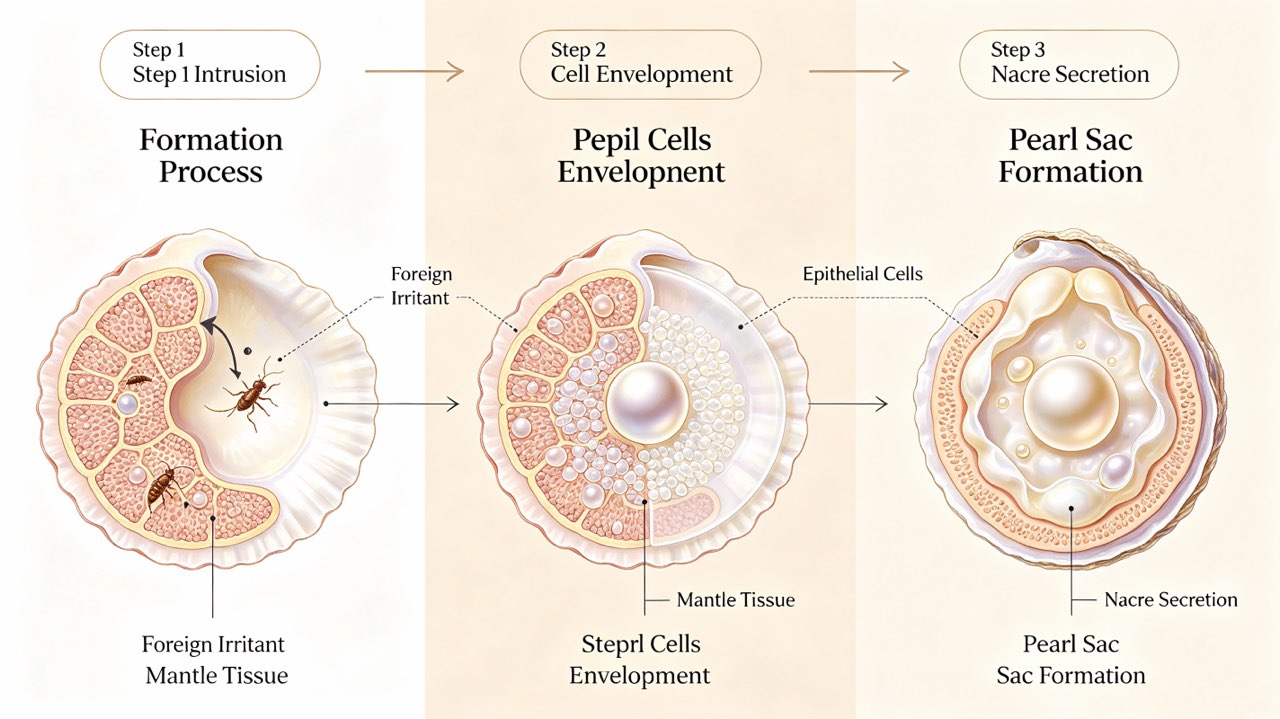
Once the intruder breaches the mollusk's internal defenses, the organism must isolate the threat to survive. Epithelial cells from the mantle tissue begin to multiply and envelop the foreign body. They form a continuous biological barrier known as a pearl sac. This sac completely seals off the irritant from the rest of the mollusk's internal organs. The cells lining this newly formed sac immediately begin secreting a complex organic protein called conchiolin. Conchiolin acts as a highly durable binding glue. It provides the foundational matrix upon which subsequent mineral layers will deposit. The formation of this sac is a defining differentiator. In wild mollusks, the sac forms organically around a microscopic anomaly. The resulting internal structure remains entirely biological, dictating the ultimate physical properties of the gemstone.
The cellular mechanics of the pearl sac determine the final shape and surface quality of the gemstone. If the sac forms perfectly symmetrically around a microscopic parasite deep within the mantle muscle, the resulting formation has a higher probability of growing round. However, if the sac forms near the edge of the shell or attaches to the shell wall, it results in blister formations or highly irregular baroque shapes. The mollusk has no control over where the sac develops; it is a strict biological reaction to the exact location of the injury.
Following the initial secretion of conchiolin, the mollusk begins the slow, unpredictable deposition of calcium carbonate. This mineral crystallizes as microscopic aragonite or calcite platelets. The mollusk lays down these platelets in alternating layers with the conchiolin. This continuous process builds the gemstone layer by microscopic layer over years or even decades. The growth timeline is highly volatile. Environmental fluctuations in wild habitats heavily impact the structural density and optical properties of the forming layers. Changes in water temperature alter the secretion rate. Shifts in the mollusk's diet affect the coloration of the conchiolin. Variations in local water chemistry can change the crystalline structure of the aragonite.
These unpredictable environmental factors ensure that no two spontaneous formations are ever structurally identical. The resulting gemstone is a direct physical record of the mollusk's life cycle and its surrounding marine ecosystem. During winter months, when water temperatures drop, the mollusk's metabolism slows down. This results in thinner, more densely packed layers of aragonite. In warmer months, growth accelerates, producing thicker layers. Gemologists can observe these seasonal growth rings under high-powered magnification, much like reading the rings of a tree.
The fundamental distinction between a spontaneous biological anomaly and a human-assisted product lies at the absolute center of the gemstone. Genuine wild formations feature concentric growth layers originating from a microscopic organic core. This core is often so small it is barely visible even under high magnification. The entire volume of the gemstone consists of solid, unassisted mineral deposition. Conversely, cultured variants rely on a surgically implanted shell bead nucleus or a large piece of donor mantle tissue. This human intervention creates a massive artificial center. The mollusk merely coats this large artificial bead with a relatively thin layer of nacre. When you evaluate the core, you are directly assessing the volume of biological authenticity. A solid interior dictates a completely different structural integrity compared to a veneered artificial bead.
The thickness of the nacre is the primary indicator of durability. A solid wild formation can withstand centuries of wear, maintaining its structural integrity and optical properties. Cultured variants with thin nacre coatings are susceptible to chipping, peeling, and cracking. Once the thin outer layer wears away, the dull, artificial shell bead becomes visible, completely destroying the gemstone's value.
Because the exterior surface of a high-quality cultured specimen can perfectly mimic a wild formation, non-destructive internal evaluation is an absolute necessity. You cannot determine authenticity through visual inspection alone. Gemologists rely on advanced X-ray computed microtomography (μCT) to visualize the interior structure. This technology generates high-resolution, three-dimensional cross-sections of the gemstone. Micro-CT scanning easily differentiates spontaneous biological growth from human-engineered nucleation.
The process of internal visualization follows a strict laboratory protocol to ensure accurate identification:
Initial X-Radiography: The gemstone is exposed to a standard 2D X-ray to identify obvious internal structures, such as a large, perfectly round bead nucleus.
Micro-CT Scanning: If the 2D X-ray is inconclusive, the gemstone undergoes a 3D micro-CT scan, capturing thousands of cross-sectional images.
Growth Ring Analysis: Gemologists examine the scans for concentric growth rings radiating from a microscopic center, confirming unassisted biological formation.
Void Detection: The scans are analyzed for internal voids or irregular cavities, which often indicate tissue-nucleated cultured formations rather than true wild genesis.
A wild formation will display tight, concentric growth rings radiating outward from a tiny, irregular center. An engineered specimen will reveal a stark contrast between the large, solid, perfectly round implanted bead and the thin outer coating. This internal visualization is the only definitive method to prove the absence of human intervention.
Not all wild formations exhibit the traditional iridescent luster associated with these gemstones. You must distinguish between traditional nacreous varieties and non-nacreous alternatives. Nacreous specimens are formed by specific oysters, such as Pinctada radiata. They consist of alternating layers of aragonite and conchiolin, creating the classic pearlescent optical effect. Non-nacreous specimens are formed by marine gastropods, including the Queen Conch or the Melo Melo sea snail. These gastropods secrete calcium carbonate in a different crystalline structure. The resulting gemstone features a porcellaneous surface that resembles fine porcelain.
Instead of traditional luster, non-nacreous varieties are evaluated on their unique "flame structure." This optical phenomenon appears as a shimmering, chatoyant pattern just below the surface. The presence of a distinct flame structure is a primary indicator of unassisted biological formation in these specific gastropod species. The table below highlights the structural differences between these two categories.
Characteristic | Nacreous Formations | Non-Nacreous (Porcellaneous) Formations |
|---|---|---|
Host Organism | Bivalve oysters (e.g., Pinctada maxima, Pinctada radiata) | Marine gastropods (e.g., Queen Conch, Melo Melo) |
Mineral Structure | Aragonite platelets layered with conchiolin | Cross-hatched bundles of aragonite fibers |
Primary Optical Effect | Iridescent luster and orient | Chatoyant flame structure and porcellaneous sheen |
Surface Texture | Smooth, pearlescent | Hard, ceramic-like, glossy |
Luster is the most critical optical characteristic of any organic gemstone. In wild formations, luster is a direct result of 100% solid nacre composition. You must evaluate the depth of this luster, often referred to as orient. Orient is the complex interplay of light refracting through thousands of microscopic, concentric layers of aragonite crystals. Because a wild specimen lacks a large artificial bead, light penetrates much deeper into the gemstone before reflecting back to the observer's eye. This deep refraction creates a unique, glowing optical effect that is unmatched by bead-nucleated cultured variants. The thin veneer on a cultured specimen simply cannot replicate the complex light refraction of a solid, biologically formed structure.
The quality of the aragonite crystals directly impacts the sharpness of the luster. In pristine marine environments, the mollusk secretes perfectly aligned, transparent aragonite platelets. These aligned platelets act as microscopic prisms, breaking white light into its spectral colors. If the mollusk experiences environmental stress, the aragonite layers become cloudy or misaligned, resulting in a dull, chalky appearance. Evaluating luster requires examining the sharpness of reflections on the gemstone's surface under a standardized, diffused light source.
When evaluating wild formations, you must accept the statistical reality of spontaneous biology. Perfect spheres are microscopic anomalies. Because the mollusk does not have a perfectly round implanted bead to guide its growth, the resulting shape is almost always irregular. Baroque, button, and drop shapes are the standard in the wild market. You must establish acceptable tolerances for these shape irregularities. Furthermore, natural surface blemishes are common. You must distinguish between minor surface characteristics and severe structural defects.
A minor blemish is a physical record of the unpredictable marine environment. A structural defect, such as a deep crack or a hollow cavity, severely compromises the durability and value of the gemstone. Collectors often prize unique baroque shapes because they serve as visual proof of unassisted biological growth. Symmetrical drop shapes are highly sought after for earrings and pendants, while button shapes are frequently utilized in rings and clasps. The market assigns specific premiums based on the rarity of the shape category.
Wild mollusks face strict biological limits regarding the maximum size they can achieve. Without a massive artificial bead to artificially inflate the volume, wild formations grow very slowly. Large specimens are exceptionally rare. When evaluating weight, the high-jewelry industry uses a specialized unit of measurement known as the pearl grain. One pearl grain is equal to 0.25 carats, or 50 milligrams. The relationship between weight and market pricing is exponential, not linear.
A specimen that weighs 40 grains is not simply twice as valuable as a specimen that weighs 20 grains. The 40-grain specimen represents a massive statistical anomaly in biological growth, commanding a massive rarity premium. Understanding this exponential weight valuation is critical for accurate market assessment. Buyers must calculate the base grain value and apply the appropriate multiplier based on the gemstone's overall quality, shape, and historical provenance.
The market places a massive premium on antique specimens with documented historical provenance. Pieces originating from the Arabian Gulf or the Gulf of Mannar prior to the 1920s are highly coveted. The 1920s marked the commercialization of the cultured revolution, fundamentally altering the global market. Antique pieces represent an era before human intervention became the industry standard. These historical beds produced some of the finest nacreous specimens ever recorded, characterized by their exceptional orient and creamy white body color.
Conversely, contemporary discoveries of gem-quality wild specimens are exceedingly rare. Decades of severe overfishing have decimated wild oyster beds globally. Ocean acidification and widespread habitat destruction further limit the ability of wild mollusks to survive long enough to produce significant gemstones. This severe scarcity of modern discoveries continues to drive up the valuation of historical pieces with verified provenance. Modern divers occasionally recover wild specimens off the coasts of Australia or Central America, but the volume is statistically insignificant compared to historical yields.
Market distinctions exist between marine formations and historically significant freshwater variants. Marine specimens, harvested from oceans and seas, have traditionally dominated the high-jewelry sector. However, wild freshwater formations hold significant historical value. Specimens discovered in the Mississippi River basin or the remote Scottish rivers during the 19th century possess unique color palettes and distinct structural characteristics. The Unio mussels found in North American rivers produced exceptional pink and purple baroque formations that remain highly collectible.
While marine variants often command higher baseline valuations due to historical royal associations, exceptional freshwater specimens with documented provenance achieve comparable auction results. You must evaluate the specific origin environment to understand the historical context and baseline market expectations for the piece. Freshwater variants typically exhibit a softer, more satiny luster compared to the sharp, mirror-like reflections found on premium marine specimens.
Acquiring these rare biological anomalies requires conceptual trade-offs. You must often accept shape irregularity and smaller overall sizes in exchange for absolute rarity and historical significance. The high-jewelry market operates on a rarity premium. A perfectly round, massive cultured specimen may look flawless to the untrained eye, but it is a mass-produced agricultural product. A small, slightly baroque wild specimen is a singular biological miracle.
This distinction drives liquidity and auction market performance. Certified wild formations consistently outperform premium cultured counterparts at international auction houses. They are treated as finite historical artifacts rather than replaceable luxury commodities. Investors allocate capital to these assets specifically because their supply is permanently capped by historical overfishing and modern environmental degradation.
The financial stakes in this market attract sophisticated imitations and deceptive treatments. You must identify common market risks to protect your capital. A primary threat involves non-nucleated freshwater cultured pearls being passed off as wild formations. Because these cultured variants lack a solid bead nucleus, they can sometimes confuse inexperienced buyers. They are grown by implanting a small piece of donor mantle tissue into the host mussel. While they lack a bead, they are still the product of human intervention and hold a fraction of the value of a true wild specimen.
Additionally, unscrupulous dealers use radiation and chemical dye treatments to mimic the highly desired natural coloration of rare wild specimens. Gamma radiation is frequently used to darken the nucleus of cultured variants, creating a gray or black appearance that mimics rare Tahitian wild formations. You must also recognize the use of advanced composite materials. Manufacturers engineer mixtures of crushed shell powder and heavy resins to mimic the specific weight, specific gravity, and surface feel of genuine organic gemstones.
Dealer guarantees, historical letters, and verbal assurances are entirely insufficient for investment-grade acquisitions. You must demand mandatory, independent gemological certification. Only reports from top-tier laboratories, such as the Gemological Institute of America (GIA), the Swiss Gemmological Institute (SSEF), or the Gübelin Gem Lab, carry the necessary weight. These institutions possess the advanced X-ray and micro-CT technology required to definitively prove internal structure.
When reviewing a gemological report, you must execute a strict verification process:
Verify the Designation: Ensure the report explicitly states the word "Natural" without any qualifying terms like "Cultured" or "Treated."
Check the Environment: Confirm whether the laboratory identified the piece as "Saltwater" or "Freshwater," as this drastically impacts valuation.
Review Species Identification: Look for the specific scientific name of the host mollusk (e.g., Pinctada maxima), which validates the geographical origin.
Examine Treatment Disclosures: Scan the comments section for any notes regarding color modification, bleaching, or surface filling.
Cross-Reference the Database: Input the report number into the laboratory's official online database to ensure the physical document matches the digital records.
Acquiring genuine biological anomalies requires shifting your evaluation criteria away from the superficial perfection of engineered alternatives. You must prioritize structural authenticity and the extreme rarity of spontaneous biological formation. To navigate this complex market successfully, execute the following steps:
Demand comprehensive micro-CT and X-radiography documentation from a recognized tier-one gemological laboratory before committing capital.
Verify the exact laboratory report numbers directly through the issuing institution's official online database to prevent document forgery.
Prioritize acquisitions that feature documented historical provenance or exhibit exceptional, unassisted optical properties like deep orient or distinct flame structure.
Consult with an independent, specialized broker who focuses exclusively on unassisted biological formations to assess fair market valuation.
A: Advanced gemological laboratories use X-radiography and micro-CT scans to examine the internal structure, looking for concentric growth rings from the center rather than an implanted bead nucleus.
A: No. Because they form spontaneously without a perfectly spherical implanted guide, natural pearls are almost always baroque, drop, or irregularly shaped. A perfectly round natural pearl is a statistical anomaly and commands an astronomical premium.
A: A natural pearl consists almost entirely of concentric layers of nacre from its microscopic core to its surface. A standard cultured pearl consists mostly of an artificial bead nucleus with only a thin outer layer of nacre.
A: No. While oysters produce nacreous pearls, certain marine gastropods (like the Conch and Melo Melo) produce non-nacreous natural pearls. These consist of calcium carbonate but exhibit a porcellaneous appearance and a unique, highly valued "flame structure" rather than traditional pearlescent luster.
A: Yes, but they are exceptionally rare. Pollution, climate change, and historical over-harvesting have decimated wild oyster beds, making modern discoveries of gem-quality natural pearls highly uncommon.
A: The price disparity is driven entirely by rarity and the unassisted biological formation process. Millions of cultured pearls are harvested annually, whereas only a fraction of a percent of pearls on the market are verified as natural.
A: Generally, no. While a jeweler can perform a "tooth test" to distinguish real nacre from plastic or glass fakes, differentiating a solid natural pearl from a high-quality cultured pearl requires specialized X-ray equipment only found in major gemological labs.


